


Connecting with Delmarva Heritage, One Trail at a Time

I was never a history person growing up. I had a hard time relating to the history lessons that were in textbooks. I studied, took tests, and then the information just left my brain. The same thing happened when I visited museums. Yes, I went on field trips to see the Declaration of Independence and the Liberty Bell, but those things were all behind glass in loud, modern cities, protected by intense security checkpoints. How on earth do you connect with the past when you’re surrounded by the present?
It wasn’t until I began my career working as an environmental educator at Delaware Seashore State Park (over 20 years ago!) that something began to click. When I walked the beach there, I couldn’t help but imagine what life was like for the surfmen that patrolled that same beach over a hundred years ago, as part of the U.S. Life-Saving Service. If I strolled the beach on a cold and windy day, it became that much more real, feeling the sand blowing in my face and enduring the uncomfortable chill in the air. Those men walked at least 5 miles every night, all winter long, in complete darkness, searching for ships in distress—sometimes during the angriest of coastal storms—with nothing but an oil-lit lantern to guide them.

I began weaving cultural heritage into almost every program I led. Kayak eco-tour? You’re paddling the same waterway the surfmen had to row across each time they wanted to see their families. Edible plants tour? You’re standing and tasting glasswort and sea lettuce in the same spot where the Indian River Life-Saving Station crew pulled their surfboat up onto the beach in 1891 in an effort to rescue several fishermen that were caught in a raging nor’easter. Guided hike? You’re gazing out over an island that is home to an ancient, sacred space belonging to the Nanticoke Indian Nation. Stargazing program? Let me tell you about the different cultures that have stories woven into those constellations. Inlet history walk? Let’s chat about coastal geomorphology and how people tried to create an inlet with dynamite in 1928.
Natural resources and cultural history are not exclusive from one another. Far from it, in fact. You cannot fully understand the natural world without understanding how humans have impacted the landscape over time. And on the flip side, you can't adequately unravel the human past of any region without understanding how the natural environment molded the story.
Fast forward to today, and tying nature and history together is still at the forefront of much of the work I do. Although this site, Delmarva Trails & Waterways, along with its social media content is largely about public lands and outdoor recreation across the peninsula, the stories that are woven into the landscapes are always on my mind. Therefore, I thought it was time to highlight some of the places I’ve visited—including a few clients and partner organizations—where I truly immersed myself in a hike, paddle, or bike ride, and ultimately left feeling more connected to those that came before me than ever before.
Please note that this list will barely scratch the surface. This list just highlights a few places that I have partnered with in my consulting work, or are places that have had a profound and memorable impact on me, personally.
Furnace Town & Nassawango Creek Preserve

Nassawango Creek Preserve was the initial inspiration for building Delmarva Trails & Waterways after my family and I went for a hike on the Prothonotary Birding Trail in February of 2020. Later that spring, I found myself dragging my 4-year-old to more trails within the preserve and the Pocomoke State Forest. That’s when I discovered Furnace Town. I had always heard of it, but hadn’t actually visited until I was craving ways to get my kid outside during the height of the pandemic lockdown. Although the site was closed, some very kind volunteers let us in to walk the grounds and hike the Paul Leifer Trail. Since all of the buildings and exhibits were closed, I was hungry to learn more about the site’s history when we left.

After a quick internet search, I learned that during the first half of the 19th century, an entire industrial village was there, with everyone working to produce iron. Bog iron ore was harvested from the nearby Nassawango Creek, mixed with clam and oyster shells that were transported up the Pocomoke River from the Chesapeake, and ultimately heated in the huge brick furnace to produce iron that would be shipped to cities like Philadelphia and New York.

It probably goes without saying, but Furnace Town only existed because of the surrounding landscape and natural resources. Today, Furnace Town Historic Site sits in the heart of the Pocomoke State Forest, surrounded by an extensive network of hiking trails. Now, when I paddle the creek or hike those trails, I’m able to imagine the work of those laborers, hauling bog ore up the creek and harvesting timber from the forest. Heck, maybe some of the trails I walk today were the same paths that hundreds of workers traversed on a regular basis.
Today, I am working with Furnace Town to hone in on their mission, expand their reach, attract new visitors (particularly those that are seeking outdoor experiences), and really lean into the surrounding landscape in all that they do.
Virginia Water Trails
Several years ago, I was doing marketing for VirginiaWaterTrails.org. I was going kayaking all over coastal Virginia taking photos, making videos, and writing blog posts to entice people to visit rural, coastal Virginia. Being able to share some of those exquisite landscapes with others was so fulfilling.
What I wasn’t expecting as I started that work was just how much I would learn about the history of coastal Virginia along the way. I circumnavigated Jamestown Island in a kayak (NOT for beginners!) and then explored Jamestown, learning about how early English settlement encroached on the Powhatan Confederacy. I also paddled portions of the Rappahannock and Potomac Rivers, which surround the region known as the Northern Neck National Heritage Area. I found myself exploring places like the Rappahannock River Valley National Wildlife Refuge, Menokin, Stratford Hall, and George Washington’s birthplace.
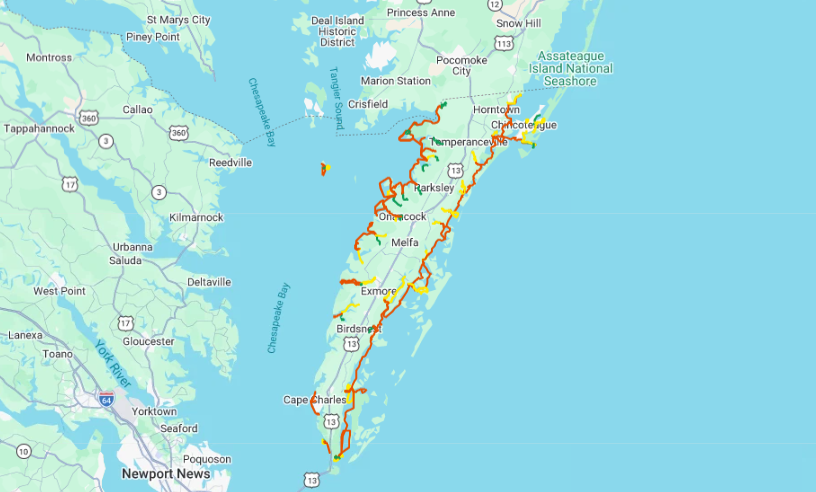
But since this is a Delmarva site; I need to highlight the Eastern Shore of Virginia. If you’ve ever paddled the waterways around this region, you know the vast majority of the waterways are quite remote, making you feel like you’re the only human around for miles—and sometimes you are the only human for miles. It’s the remoteness though, that evokes my curiosity the most. Hundreds of miles away from the Smithsonian and those fancy museums in bustling cities, it is places like Messongo Creek, Gargathy Bay, and Occohannock Creek where I’ve been able to imagine paddling a log canoe on these same waterways a thousand years ago. Sure, the landscape doesn’t look exactly as it did a thousand years ago, but the sandy beaches and lush Spartina grasses make me feel just a tiny bit more connected to those that came long before me.

And when I venture from a narrow creek to the open bay and spot a freighter in the distance, I wonder how terrifying it would have been to be a member of the Occohannock or Accomack Indian Nations, watching from the shoreline and seeing a large 17th-century European ship moving up the Chesapeake Bay for the very first time.

That’s the power of spending time outdoors. A single gaze across a landscape can seemingly peel back centuries in an instant.
Stay tuned for Part 2. Follow on facebook, instagram, or sign up for my newsletter.


